
Shock–Boundary Layer Interaction: Compression Ramps
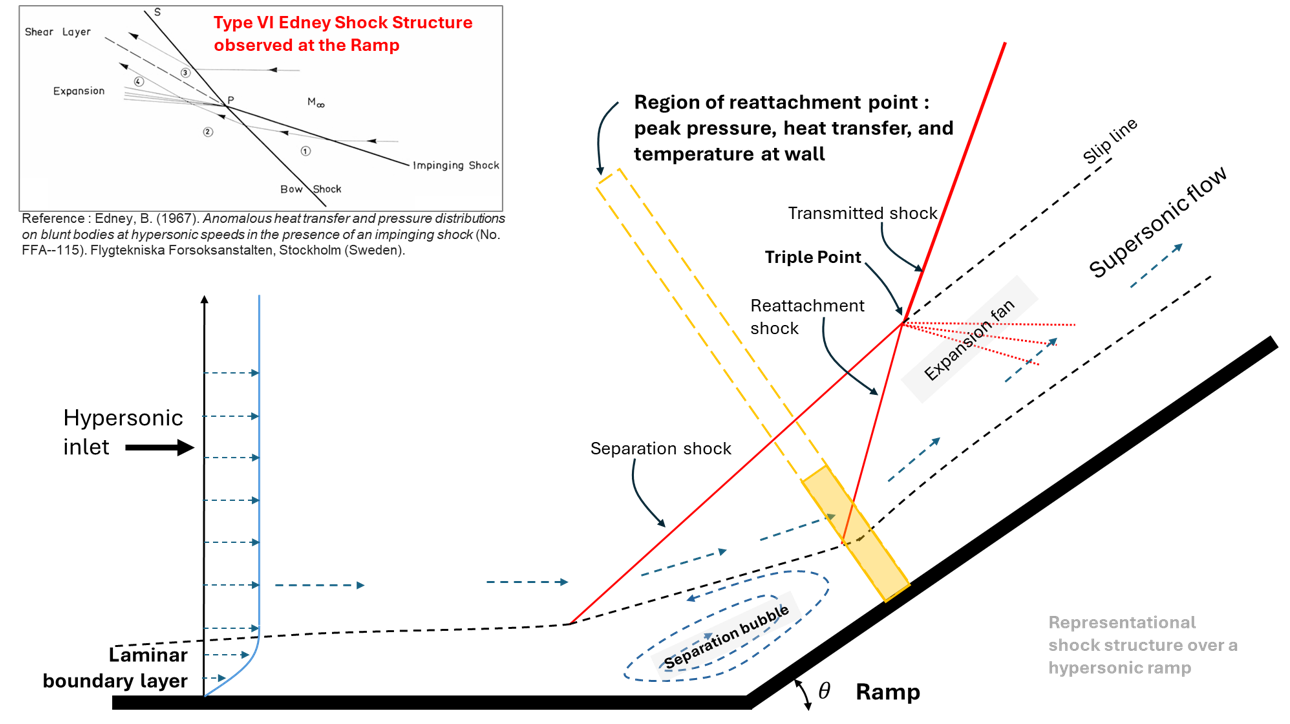
Unlike external shock impingement, compression ramps introduce an interaction that is intrinsically coupled to geometry. A turning surface generates an oblique shock that interacts with the incoming boundary layer, imposing a strong adverse pressure gradient that fundamentally alters the near-wall flow.
Shock Formation
The response of the boundary layer is governed by ramp angle and flow conditions. Even moderate deflections can induce separation upstream of the corner, forming a recirculation region bounded by separation and reattachment shocks. This interaction is not confined to the corner; it extends upstream through viscous–inviscid coupling and downstream through reattachment dynamics. (Ref: John et al.)
At hypersonic conditions, the shock structure itself becomes embedded within the boundary layer. Direct numerical simulations at Mach 7 show that for shallow ramps, the shock remains immersed over several boundary-layer thicknesses downstream, continuously interacting with turbulent structures and exhibiting strong unsteadiness. This coupling drives rapid amplification of turbulence and thermodynamic loading. High-fidelity simulations of compression ramp interactions further show that the separated shear layer is highly susceptible to instability growth and rapid breakdown, reinforcing the role of the interaction region as a transition trigger. Ramp-induced interactions can trigger or promote transition, often shifting it upstream into the interaction region itself. (Refs: Adams; Benay et al.)
System Implications
The surface response is highly non-equilibrium. Heat transfer is strongly amplified through the interaction, with peak heating typically occurring near reattachment, often exceeding canonical turbulent levels. In such flows, heat flux correlates more closely with pressure than with skin friction, reflecting the breakdown of classical analogies. (Ref: Piebe & Martin)
From a system perspective, compression ramps are inherent to hypersonic vehicles. Scramjet inlets, for instance, rely on a sequence of compression ramps to generate the required pressure rise. The resulting shock–boundary layer interaction governs inlet stability, separation control, and localized thermal loading, directly influencing operability margins and material limits under flight conditions.
The key implication is that transition and heating cannot be treated as a downstream boundary-layer problem alone. In ramp-driven configurations, they are directly imposed by geometry through the interaction itself.
References:
John, B. et al. : https://lnkd.in/eHaT9tVE
Adams, N.A. : https://lnkd.in/eKbPvz3e
Benay, R. et al. : https://lnkd.in/emBi7svt
Priebe, S. & Martin, M.P. : https://lnkd.in/euJi7v7r
